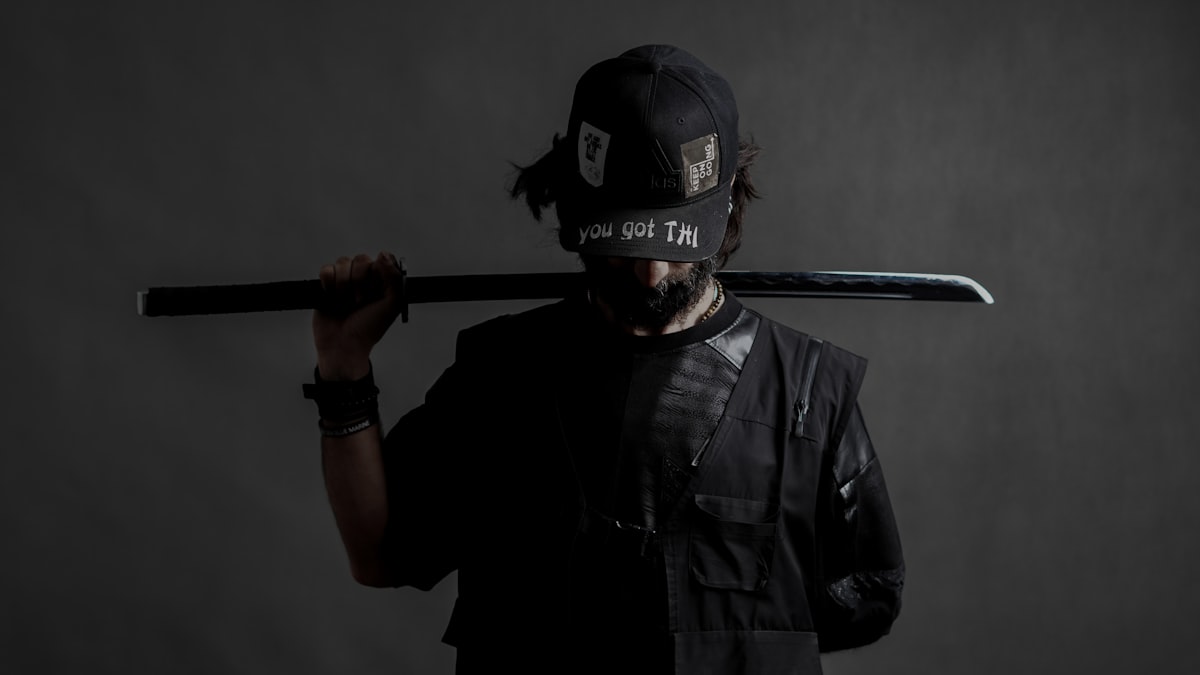
The Warrior Who Never Lost: Musashi's Rules for Surviving the Crypto Bear
In 1645, Miyamoto Musashi climbed alone into a cave called Reigando, on a mountain in Japan, and did not come back down.
He was seventy-three years old. He had fought sixty duels in his life and won every single one. He had killed his first man at the age of thirteen. He had walked through battlefields that consumed everyone around him. And now, sensing the end approaching, he picked up his brush and began to write.
He called it Gorin no Sho — The Book of Five Rings. A manual for the warrior's mind. He finished it forty days before he died.
I read it for the first time sitting in a rented apartment in Buenos Aires, staring at a screen that had just shown me half my life savings disappear in a single trade, wondering if I had made the worst decision of my life.
The Road That Led Me Here
I spent twenty years as a systems architect in the United States. I designed distributed systems. I built infrastructure that handled millions of requests per second. I was good at it.
Then two things happened at the same time.
The cost of living in America crossed a threshold I couldn't rationalize anymore. Not a dramatic collapse — just a slow, grinding deterioration. The numbers stopped working. The quality of life I was buying with my salary kept shrinking, year by year, in ways that were hard to explain to people who hadn't watched it happen from the inside.
And then AI came for my profession. Not all at once. But I watched it happen in slow motion — the work getting thinner, the leverage shifting, the compensation compressing. I saw where it was going before most of my peers were willing to say it out loud.
So I made a decision. Leave. Reinvent. Find a domain where discipline and intelligence still have asymmetric upside. I chose crypto trading — not because it was safe, but because it was honest. The market doesn't care about your resume. It doesn't care who you know. It punishes weakness and rewards rigor. It was the only fair fight I could find.
I entered the arena like a man who had studied maps but never held a sword.
The market taught me what that felt like.
The First Defeat
It happened in a single trade.
Not a slow bleed. Not a series of small mistakes that added up. One position, one moment of absolute certainty that turned out to be absolute arrogance — and half my net worth was gone before I could close the tab. Everything I had saved across years of work as a systems architect, everything I had moved across an ocean to protect, cut in half in a single session.
I sat there for a long time without moving.
Then I told myself the story every defeated trader tells himself: the thesis was right. The timing was just wrong. I would recover. I just needed more time.
Musashi wrote: "Do not think dishonestly." It is the first principle in The Book of Five Rings — the very first thing he says. I had been thinking dishonestly about my own performance from the moment I entered that trade. I had confused confidence with preparation. I had confused conviction with edge. I had walked into a duel I had not earned the right to fight. I was walking into duels I had not prepared for, with weapons I did not understand, against an opponent I had not studied.
No warrior survives that. Not for long.
I went back to the beginning. I stopped trading. I started studying. And slowly, three instruments emerged from the noise that I could actually trust.
The First Weapon: Read the Water, Not the Wave
Musashi understood terrain. Before any duel, before any battle, he studied the ground he would fight on. The angle of the sun. The position of shadows. Where his opponent would have to stand. He called this knowing the ground — and he said a warrior who ignores terrain has already surrendered half his advantage before the fight begins.
In markets, the terrain is liquidity.
Most traders watch volume — the number of trades, the size of candles, the activity on the chart. Volume is the surface. Liquidity is the ground beneath it. Macro liquidity is the total capital that central banks are pumping into or pulling out of the financial system. It is the water level that every asset floats on.
When central banks expand, money flows into risk assets. Bitcoin is a risk asset. The mechanism is structural — more liquidity in the system means more capital searching for yield, and crypto sits at the far end of that spectrum. When liquidity contracts, the opposite is true. The water level drops. Assets that looked strong begin to sink.
I spent months fighting volume breakouts while the water level was dropping. Every long I entered failed. I blamed my entries. I should have been reading the terrain.
The warrior who does not know the ground cannot win, no matter how sharp his sword.
Volume is the wave. Liquidity is the ocean it rides on. Watch the ocean.
The Second Weapon: Know Where the Enemy Lives
Musashi studied his opponents before he faced them. Their habits. Their tendencies. The way they held their sword. He wanted to understand how they thought — because a man's thoughts determine his movements, and his movements determine where he will be vulnerable.
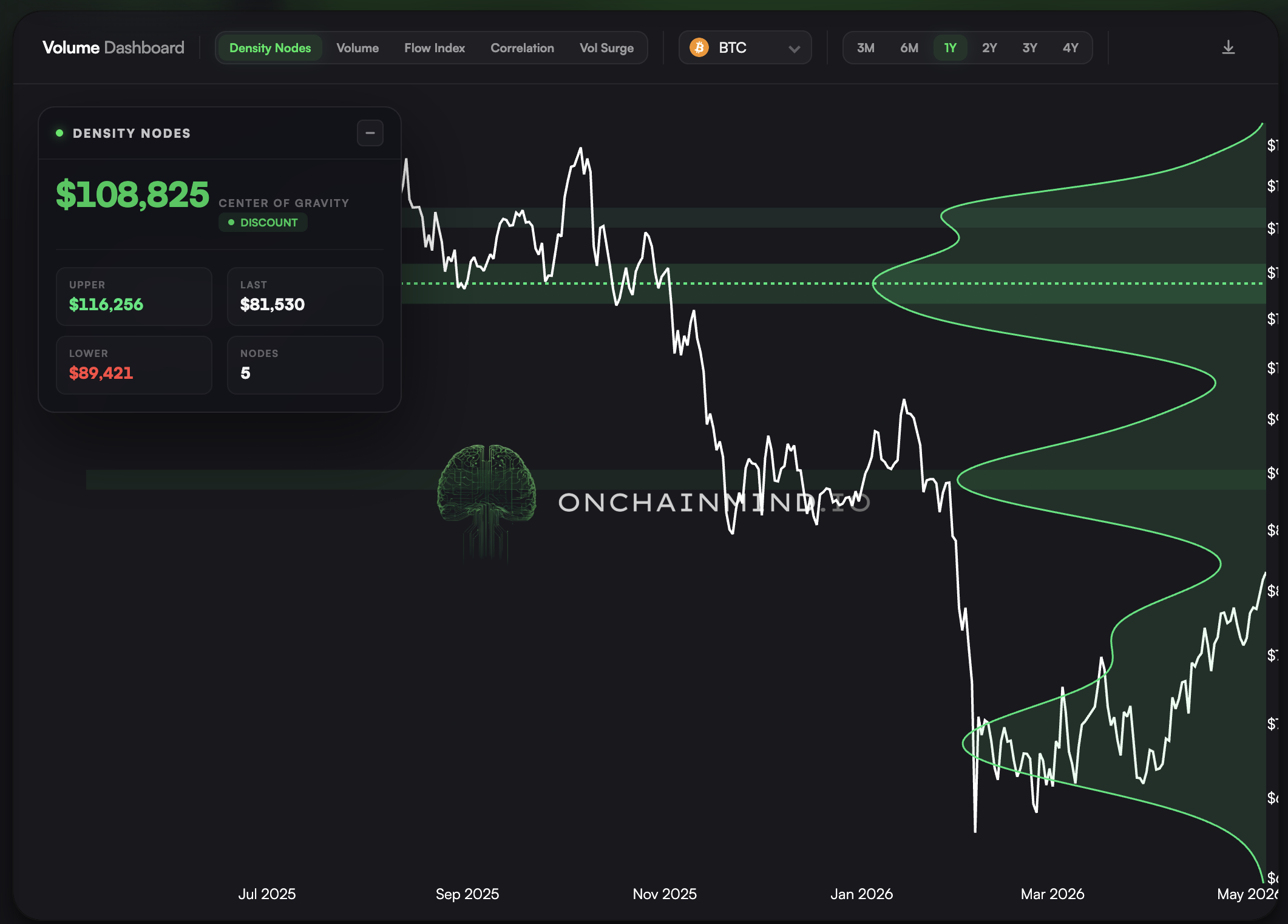
Markets are made of people. And people have a cost — a price they paid, a level at which they feel safe or exposed. On-chain data lets you see exactly where Bitcoin holders bought their coins. It tells you their cost basis. And when you know where people live, you know how they will behave when price comes near that level.
I track three levels:
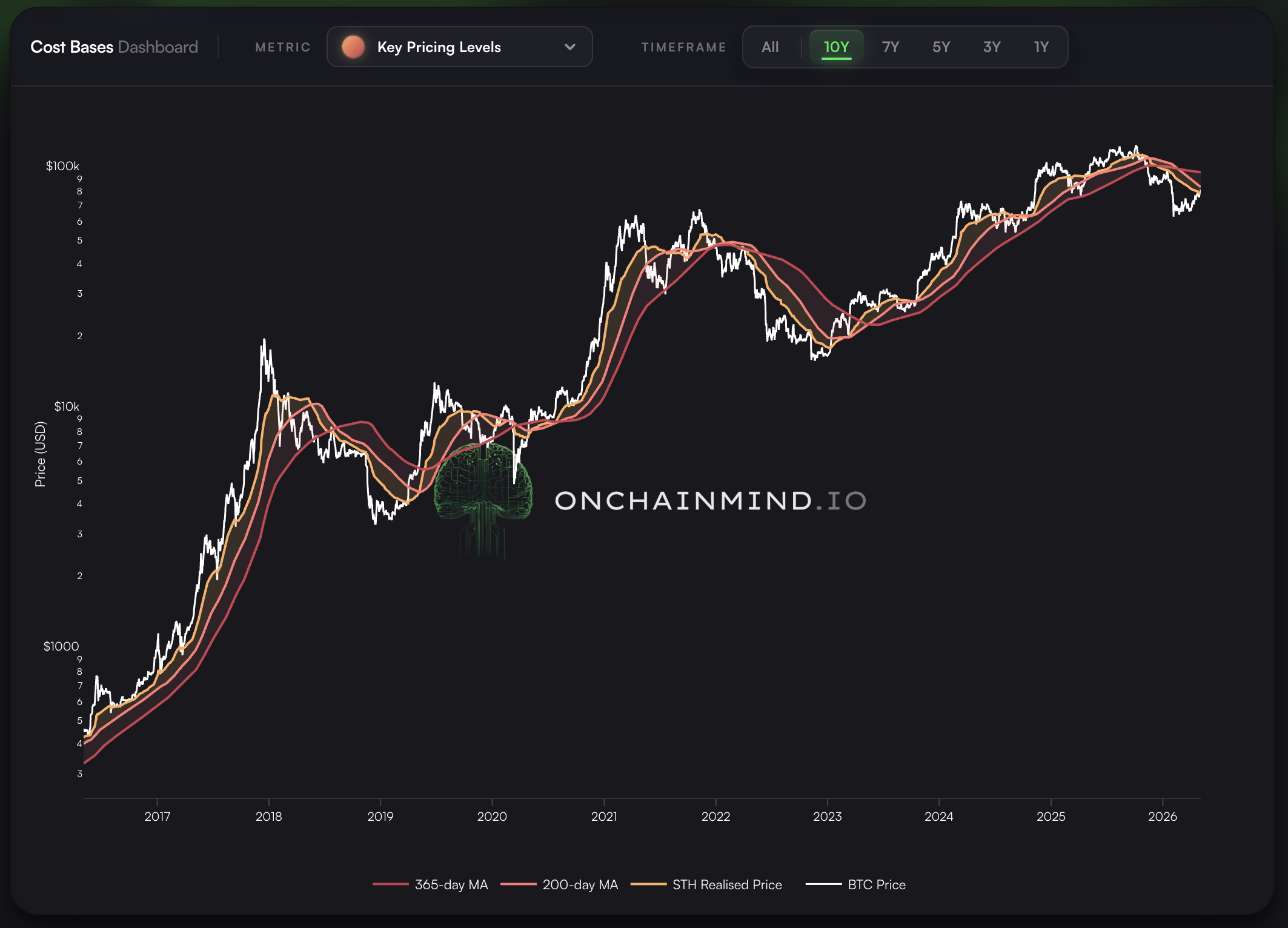
The Short-Term Realized Price (~$78K) — the average cost of coins that moved in the last 155 days. This is where recent buyers are stationed. When price descends to this level, they are at breakeven. Just below it, they are in pain. Pain produces panic. Panic produces capitulation. And capitulation, when the larger environment supports it, produces the cleanest long setups in the market.
The 200-Day Moving Average (~$83K) — the line the institutional world watches. Fund managers, algorithms, risk systems — all of them have this level marked. It is the consensus boundary between bull market structure and bear market territory. When price reclaims this line from below, something has shifted. The whole market feels it.
The 365-Day Moving Average (~$96K) — the yearly average, the rough breakeven of longer-term holders across a full cycle. In bear markets it acts as a ceiling. In bull markets it becomes a floor. A sustained reclaim here is the market saying: the cycle has turned.
These levels work not because of mathematics but because of human nature. Real people with real money bought at these prices. Their fear and relief when price crosses these lines is predictable. And predictable behavior, in any arena, is an advantage.
Know where the enemy lives. Know how they will react when you approach.
The Third Weapon: See the Shape of the Moment
Musashi described a concept he called kan — a deep perception that goes beyond what the eyes can see. Most swordsmen watch the blade. Musashi watched the whole man. His breathing. The tension in his shoulders. The micro-signals that preceded every move. He was reading probability before the action unfolded.
Z-score is as close as I have found to kan in trading.
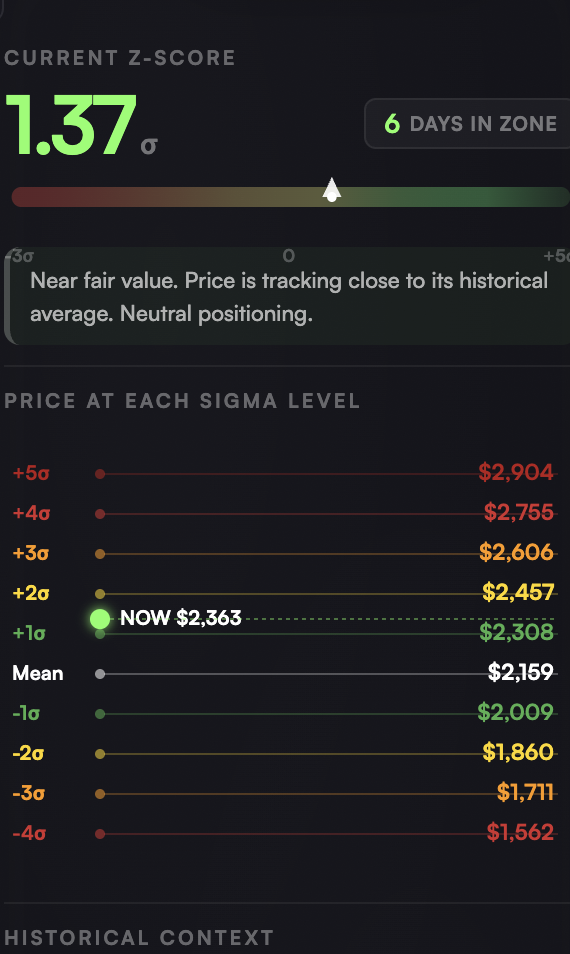
Most traders see price in terms of levels — support, resistance, highs, lows. Z-score sees price as a position within a distribution. It measures how many standard deviations the current value sits from the historical mean. It answers a question that level-based thinking cannot: how unusual is this moment?
When Z-score rises above +2, price has entered rare territory. The probability of continuation decreases. The probability of reversion increases. Not a guarantee — a probability shift. The same logic applies below -2, in reverse. You are not predicting what will happen. You are reading the shape of the moment and tilting the odds.
When Z-score aligns with cost basis — when price sits at the Short-Term Realized Price and Z-score reads -2 — two separate lines of intelligence point at the same conclusion. That is kan. A perception deeper than any single signal. That is when I act with full conviction.
Most traders never stop thinking in levels. The ones who learn to think in distributions see a completely different market.
The Code of the Warrior Trader
Musashi spent forty days in that cave distilling sixty years of combat into principles any warrior could carry. Here is what I carry from him into every trading session:
Set the mind before the battle, not during it. Musashi never stepped into a duel still deciding his strategy. The duel was execution. All preparation happened before. I follow this exactly. My levels, my signals, my thresholds — everything is set before the market opens. Once price is moving, I am not thinking. I am executing. The trader who makes decisions under the pressure of a moving position has already surrendered the advantage.
Anticipate three outcomes before any engagement. Before each duel, Musashi prepared a response for three scenarios. I do the same before every trade: what do I do if price goes with me? What do I do if it goes against me? What do I do if nothing happens? If I cannot answer all three before I enter, I do not enter. Entering without this preparation is not trading. It is gambling with extra steps.
Control the body to command the mind. Musashi taught his students to use breathing as a lever over their internal state. In moments of high tension — when a position is moving against you and your chest is tight and your mind is starting to spiral — the breath is the only thing you can control. Slow it deliberately. The market will still be there in sixty seconds. You need to be rational in those sixty seconds. This is not philosophy. It is physiology. Use it.
Know your desired outcome before you begin. Musashi never entered a duel without knowing what victory looked like. I never enter a trade without a defined exit — a specific price, a specific condition, a specific signal. Not "I'll let it run." A number. A rule. Vague targets produce vague exits. Vague exits produce emotional exits. Emotional exits produce losses. Define the victory before you engage.
The Discipline of Stillness
Musashi, at the height of his power, was famous for something that seemed like weakness: he often arrived late to his duels. His opponents, waiting, would grow anxious and lose composure before the fight even started. He used stillness as a weapon.
I have learned to do the same.
The three metrics — macro liquidity, on-chain cost basis, Z-score — tell me when to act and when to wait. And most of the time, the answer is to wait. To be still. To not be the trader watching every tick, generating reasons to enter, mistaking activity for progress.
When all three align, I have a high-conviction setup. When they conflict, there is no setup. Honor the discipline enough to step back and do nothing.
Two decisions only: in or out. Long or short. That is the full range. If the signals are not clear enough to point firmly in one direction, the honorable choice — the warrior's choice — is stillness.
Set your alerts at the levels that matter. Close the chart. Do not return until something worth seeing has happened. The trader who watches every tick trains himself to react. Musashi did not react. He perceived, prepared, and then acted with complete commitment when the moment was right.
The Cave
I think about Musashi sometimes, sitting alone in that cave at Reigando, writing in the dark.
Sixty duels. Sixty victories. And at the end, not pride in the winning — but a quiet, disciplined documentation of how. So the knowledge would survive him.
He understood something I had to lose half my life savings to understand — in a single trade, in a single session, in one moment of unchecked arrogance: victory is not the product of talent. It is the product of preparation, perception, and the refusal to act dishonestly about what you see.
The market is a worthy opponent. It has no mercy and no memory. It will take everything from a trader who steps into the arena without a code.
I found mine in a cave on a mountain in Japan, written by a man who had already won every fight he would ever fight — and still thought the most important work was understanding why.
Study the terrain. Know where the enemy lives. See the shape of the moment. Set your mind before the battle. Define your victory. Control your breath.
And then — only then — draw the sword.
Leon Yeh is a former systems architect turned active crypto trader, currently based in Southeast Asia. He writes about trading, technology, and the long road of reinvention.